Showing posts with label new product development. Show all posts

Monday, August 1, 2022

Business Concept Statement

A business concept sums up the most important points of a new idea for a business, brand, product, unique selling point, product line, project and so on. Technically therefore, it can be renamed accordingly like 'product concept', 'brand concept' and so on. It is usually communicated in an official concept statement, ie a concise statement of roughly 100 words or less that answers several key questions.


Uses & Benefits of a business concept statement

  • The concise statement helps to effectively pitch ideas for new business development or new product development to potential investors and other stakeholders. It can therefore be used as the concise way in which you introduce yourself and business plan.
  • Potential investors use the concept statement to determine the 'viability' of a proposal (ie the ability of the idea to become functional, has a reasonable chance of success)
  • Businesses provide a concept statement to provide institutional information in a concise way to the public. 
  • The concept statement helps everyone developing the new idea to remain on point. Business development consultants can steer small business owners to streamline the conceptualization of new business ideas. Consequently, it is often the starting point from which consultants offer their services.
  • The concept statement is the clear guidelines from which the worthiness of ideas that deviate can be assessed as potential pivot points. (Read about pivot points)


Contents of a business concept statement

A good business concept explains the following. 

  • market opportunities.
    • market pain point or problem you can solve
    • no one else is fulfilling a need better than currently
    • gaps in any of the 4Ps or 7Ps. This may be based on the weaknesses of your competition and or gaps on a plotted competitive brand positioning graph.
  • the target market profile
    • B2B vs B2C
    • segmenting variables
      • demographics, psychographics (B2C)
      • industry, employees, revenue, online or brick & mortar, serving local or international markets, seasonality, innovators or followers, affiliations / friends, core values (B2B)
    • a niche
  • benefits to prospective investors
  • reasons for creating the idea. Example(s)
    • gap in the market
    • no current businesses cater to a certain community. (This can be compelling, especially if it relates meaningfully to your personal story)
  • the differentiating factor or unique value proposition (UVP) as it relates to how it provides competitive advantage over your competition
  • the distribution method(s) that allows customers to access your offering.
  • the business model, ie details the 
    • financial side of the concept 
    • how to make it profitable
    • how to experience revenue growth, like how much the product or service might cost, along with the resources to ensure its financially successful.
  • mission regarding performance and key milestones along the way to achieving the mission.


Example(s) of a business concept statement

  • New business concept. A line of luxury restaurants that cater to a broad range of customer needs including veganism and keto.
  • New product concept. A line of luxury cosmetics that cater to  the natural and ethical skin care movements.


CONTENT RELATED TO THE BUSINESS CONCEPT STATEMENT

Tuesday, January 18, 2022

Minimum Viable Product (MVP) - New Product Development (NDP)


This post will extend the earlier discussion on the process of New Product Development (NDP) by introducing a slightly different slant. Specifically, creating a Minimum Viable Product or MVP (aka 'earliest testable product' or 'lean startup product') is an approach to market entry that is faster, overall cheaper and less risky. It aims to test and validate critical assumptions (as those related to customer perceived value and buying decisions) in the real market during the product development process. 


The Product: characteristics, raison d'ĂȘtre, types

At this stage of your product's development, your MVP requires the minimal effort to produce because it a basic, least-featureful but launchable version of your final product. However, it already has must-have features that fulfill your brand's basic functional value proposition

Consequently, it is sufficiently useable to attract early adopters into your product's life cycle. You need those early adopters to test your assumptions regarding customer perceived value so that you can learn how best to further develop and improve the product idea. To be clear, you are not as interested in earning profits at this point. Rather, your primary objective is simply feedback. 

'Product' does not only refer to a physical good or service in the conventional meaning. Its definition can also mean the 'extended' product as seen in the Zappos case study below in which the physical product (shoes) was not subject to new development. Rather, the distribution channel was.

Timing is important for the MVP process. So since the MVP needs to advance through subsequent iterations within only days to weeks, not all final products fit the model as easily. Such products need to comply with many legal and other requirements like biotech, insurance, banking and so on. As discussed below, there are different types of MVP (like the smoke screen MVP) whose design allows even such 'heavy MVPs' to have similarly fast turnaround times within the NPD model.


Differences between the MVP and conventional MVP processes of NPD 

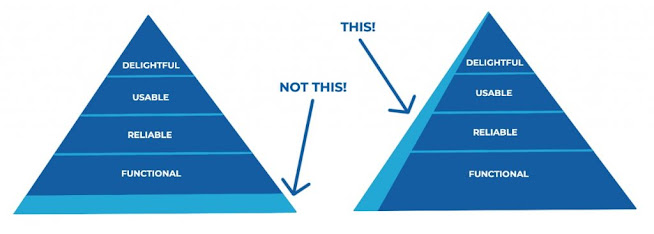
The diagram immediately below is a famous illustration of the evolutionary difference between the conventional NPD process (represented by the pyramid to the left) and MVP approach (represented by the pyramid on the right). Both pyramids are based on Aarron Walter's hierarchy of product user needs (which is similar to Maslow's hierarchy in terms of progression through the different tiers). The tracking of product development starts at the base with the most basic MVP version and advance upwards, ie achieving and or maximizing functionality, reliability, usability and desirability
Reliability refers to whether the product performs according to a prescribed specification under normal usage with little or no reduction in performance. Famous examples include the famous Energizer Bunny was expected to perform for X hours under normal x usage. A classic definition of reliability is 'the probability that a product will perform successfully under specified operating conditions for a given time period' (or, for a specific product, I would say within a given range). In other words, reliability is a measure of quality over a key variable (time or other consumer-important variable). It is usually tested by repeated the environmental stressors. Reliability is very heavily based on performance. Other good examples include performance requirements for jet engines that need never fail during flight and therefore require even more stringent reliability testing. Reliability is arguably a more advanced form of functionality. It is often confused with the sometimes related construct; durability. (Durability relates to whether the product structurally fails). In either case, testing requires applying as many risk scenarios as possible, even acid testing based on improper use by consumers. (See discussion on 'reliability failure rate, a key reliability index)/

In the conventional approach, the development team allows the evolving product to advance through all the phases on the pyramid, out of sight from the public. It is only after having completed all of those phases in privacy does the product get launched for public use. 

Conversely and as illustrated by the second pyramid (for the MVP method); once the product can provide basic functionality, it is produced into an MVP and then immediately launched for sale into the market. 

This method essentially invites the target market to act like part of the development team to test hypotheses. As mentioned  above, doing this is for the sake of gathering feedback from real market circumstances. From that point, each successive iteration develops and improves the product based on real consumer feedback and purchase decisions. 

This approach recognizes that the conventional survey methods of simply getting opinions often produces results that lack reliability or validity regarding market's buying behavior. For instance, a well known challenge with research is that respondents do not always buy when given the chance, even after they had just indicated that they would buy in opinion-based surveys. In short, the MVP approach avoids a manufactuer's risk of making false killer assumptions. 

The changes are called 'pivots'. Pivoting quickly and in ways that improves the product is what separates the successful from unsuccessful entrepreneurial pursuits.


Product Launching

Here is the advice that consultants offer to startups.

Michael Seibel's recommended startup launch goals should be to 
  • 'launch quickly"
  • "launch something bad quickly"
  • "get initial customers" (to see if / how they can get value). 

Reid Hoffman said: 
  • If you are not embarrassed by your first product, you launched too late.”


The early MVP launch therefore presents a second understanding of the concept of product launching. An MVP launch is low key which differs entirely from the other more conventional, highly publicized 'press launch'. Whether you choose to do both is up to you. However, the low-key approach is suggested to be more important for product success.

Consider cases of hugely successful companies whose launch dates were not known to the public. They likely seemed to have suddenly appeared out of nowhere, when in reality and to your surprise, they had been in operation for several years. 

Cases in point include Google and Facebook. AirBNB's initial website in the early 2000s was so lacklustre that it did not even have online payment facilities or maps (very important, value adding features). 

Ultimately and as Seibel suggests, one might as well forget the notion of one ultra special launch.  


Uses & Benefits

  • An MVP allows you to hasten market entry, especially if time is of the essence for competitive advantage, even with a small budget.
  • An MVP reduces the risk of product failure, or at least failure from which you can not recover because it is so public. It is clear from case studies of failed growth strategies (Ansoff Matrix) that businesses run the risk of failure if they hold incorrect assumptions about market needs. Here is a useful statistic. Startups that scale correctly grow 20 times faster than those that scale prematurely.
  • The MVP approach reduces R&D costs. Afterall, by applying an MVP to the NPD process, you essentially allow yourself to get paid while you develop the product. This is noteworthy because as many as 29% of startups fail because of cash flow deficits.
  • To get insight not only into production issues but also other elements within the marketing mix, like advertising, pricing and distribution.


  • Case study: Zappos. When the internet was still in its infancy stage in 1999, the founder of Zappos wondered whether his at the time novel idea of online sales could actually work (in other words, his hypothesis / testable assumption). Instead of conducting time-consuming and costly market research and setup, he took images of some shoes from stores nearby then posted the images onto a basic website. When his website visitors placed orders, he purchased the shoes and then shipped them out which was a manual version of the proposed final automated version. In reality, he lost money on each sale. That was fine because the process did precisely what is was supposed to; it allowed him to test the hypothesis that the public was willing to buy online. Once he got his confirmation and understood their needs from the experience, he converted his idea into a fully functioning business which was eventually sold to Amazon for over USD 1 billion.

    Case study: IMVU designed an app to allow users to interact with friends online while presenting themselves as avatars. The concept gave creators enormous confidence because it combined 2 trends that were very popular at that time; 1) 3-D gaming and 2) instant messaging. What could possibly go wrong?! Confident about their innovation, IMVU worked tirelessly for 6 months to develop their product. Ultimately, their new app integrated all the major instant messaging applications (like AOL and instant messenger). Being confident their new app would be an instant winner, they launched it. However, the public reaction was dismal. The public simply did not want to download the application. In desperation, the team invited in the target market to use the product while discussing their experience. Ony then did IMVU realize that the problem was that their development team had made incorrect assumptions regarding customer pereceived value. Specifically, rather than want to use established instant messaging applications, customers wanted to use a new messaging media that could even allow them to safely make new friends of strangers (not speak with the current friends). In other words, spending 6 months integrating established messaging systems was a colossal waste of time and money. Fortunately, in this case, the business was able to pivot to resolve this matter at that early stage rather than go out of business (as many others do). The lesson is that, if a small sample of the target market tested the product with only 1 established messaging system, it would have become evident from much earlier that there was no point installing all of the established messaging apps. In short, IMVU should have tested the hypothesis / assumption of whether their target valued pre-existing instant messaging apps


    Case study: 
    YouTube's case demonstrates the power of being sufficiently flexible to listen to what consumers want and to respond by pivoting away from an original beloved idea. YouTube started as a lackluster dating site.


    Sub-optimal product development outcomes.

    • Crash dummies and many other types of safety equipment were based on only particular body types, usually a statistically average male body. Consequently, these products have been historically less safe for people with atypical body types. In addition to 
    • In the medical industry, since the contraception pill was tested on women under 165 lbs, it is less effective for women over that weight.  


    Dream Big, Start Small!

    Let go of ideas that are not serving customers. Do not become emotionally attached. Pivoting is your friend!


    Process

    1. Do target market research into what the market absolutely needs of the product's functionality. A CB Insights survey and Dan Olsen separately suggested that the leading reason for startup failure was a failure to meet market needs. In the latter case, he suggested that the need should meet those needs 'better than the alternatives' which is a reminder that market research should also involve analysis of the competitive landscape. (See my discussions on brand positioning, Porter's Generic Strategies including a focus on differentiation, costs and so on). Also learn as much as possible about the target market, including purchase triggers.
    2. Write a development plan. It is easy to recognize that you are changing plans or going off course if you can refer back to the plan.
      1. Establish product-specific identifiable markers for beta and MVP versions (if they are even different in your business).
      2. Identify your critical assumptions to be validated that, if incorrect, run you the risk of losing a lot of time and effort or even product failure. See assumptions in the case studies. Other examples include: 
        1. do customers perceive your value proposition(s), brand positioning as you expect?
        2. does the MVP actually resolve the core problem? (Ideally, you should resolve this as a preliminary step to an MVP launch. In some cases, this can be an ethical issue. Think of the Theranos case).
        3. what are the specifications? 
        4. will customers buy the product (at a certain price)?
      3. MVP launch date(s)
      4. Set dates for introducing new adjustments 
    3. Create an early, non-special version to serve only as a base or starting point from which your product can evolve. Apply only the must-have, most highly ordered core feature to the minimum viable product. Do not attempt to deliver all needs immediately. However, to be clear, the MVP should NOT be low quality, simply the most basic version the product can be acceptable to share with the market. For this step, use the MoSCoW method for prioritizing the features, specifically the must-haves (or non-negotiable features), should-haves (important and should be included but the quality  may be compromised, at least for the time being), could-haves (less critical features that are more like nice-to-haves) and won't-haves (offer the least business value and will be currently excluded). You should be able to clearly identify when you have achieved the MVP stage of your product's development. Here are the 2 most common approaches.
      1. Conceirge MVP. This involves creating a very inexpensive mockup version of what the full scale operation will look like. The Zappos case study illustrates this. Had IMVU used the MVP approach, their conceirge MVP would have allowed target customers to test the product with only 1 messaging application. Other examples include course outlines and outline of services being provided in the academic industry. One pain killer feature MVPs are based on the single most critical feature that tackles the brand's UVP. The key functional UVP will be the result of the  'M' in the MoSCoW technique for prioritizing the feature.
        1. Case single pain killer MVP. An application was established with only one feature that a team needed; to manage very long checklists. The application was free of cost. However, when demand was clear that the market wanted other features on the very bare minimum product, the team then created an add-on feature and began to operate the application for profit. Even though the business had competition, they used strategy, specifically; brand positioning of a meaningful UVP to develop the new feature. See video.
      2. Smoke Screen MVP. Like the name suggests, this type of MVP involves creating an illusion of the final product, even before the product was even built but collecting preorders to gauge customer reaction to the plan. Smoke screen MVPs are well suited to the case of heavy MVPs. Other examples include the Exploding Kittens card game is a case in point. A 2-minutes video described the game, how to play and invited preorders. The preorder resulted in millions of dollars in earnings which validated the assumption that people would actually buy the product
    4. Set a price, even if it is slightly lower than otherwise. Encourage customers to pay as soon as possible. Charging allows you to validate the assumption that they are willing to buy. Additionally, paying customers will likely provide higher quality feedback, especially if they feel strongly about your product one way or other. If possible, resist the common temptation of allowing customers to use your product free of cost. By setting a price or some barrier to use, you will see how strong their problem and consequent desire is to use your product anyway. Free loading customers can be misleading as they might not truly have the problem of the target market but simply want to test out a free product.
    5. Recruit a small sample of the target market to test the product. The best MVP test customer is the one who suffers the problem to a desperate extent (NOT your friends who are only barely aware of the problem). Avoid people who can simply exploit a free or easy ride. Finding customers may involve approaching handpicked B2B customers via LinkedIn or Facebook advertisements that encourage interested persons to pre-order. At every point, analyze customer responses, even click rates and viewing time of advertisement videos and so on. Have performance measures.
      1. Examples, if video advertisements are being watched fully and your ad gets many clicks but not many pre-orders, you may need to improve the product design to be more attractive.
      2. Examples, if your video advertisements still do not get beyond 2% conversion even after 'pivots' (ie improvements based on public response / feedback), the product may simply not be viable.
      3. Examples, if response rates improve after each pivot, you may 'persevere' (ie proceed with the product development project).
    6. Set up 2-way communication systems with consumers that are keen to engage.
      1. Proactively avoid dis-satisfaction; inform the market that the product is being tested and you want his or her input. 
      2. Create a survey that seeks feedback to address all marketing mix and branding (positioning) issues. The survey should use data collection triangulation, ie its data should be both qualitative and quantitative in order to get the benefit of using both types of data.
    7. Set up metrics. Among the best KPIs is sales (for a paid product) or usage (for free products). Depending on the product, metrics may also include responses from survey questionnaires. However, it may also be as broad as monitoring website activity like visitor actions before and after abandoning carts, time spent looking at the product page and so on. Resist the temptation to use hundreds of analytics. Rather, select roughly 5 to 10 useful statistics to track. 
    8. Be flexible. Do not fall in love with your MVP. Specifically, prepare to pivot and or iterate when necessary. Needless to say, this involves hiring a team that is sufficiently qualified to complete the cycle of analyzing and responding and at the right pace to market feedback. Test all aspects of your (extended) product, including branding, your assumptions about the phase in which customers are within their buying decision (as they relate to packaging design), etc.
      1. Pivoting refers to radical changes of the current product to capitalize on different market opportunities. For instance, if your market comprises mostly of people with oily skin and they do not appreciate your product that is very conditioning, you may pivot to make your product more suitable to the mode skin type
      2. Iteration refers to incremental (NOT drastic) changes to the current product. For instance, if your current product requires more intense oil control for oily skin, your product formulation may add a little more charcoal (which draws out oil) than the previous iteration. BTW, For each subsequent iteration, as much as possible, increase costs and complexity only incrementally and as clearly needed, ie versus attempting to immediately maximize the product and budget development. For instance, if your product is a cake. Rather than use all of the toppings available to you from the beginning, test the product with the least number of new additions like cherries for iteration 2 rather than cherries, icing, dolls and glitter. Needless to say, to quickly advance product development, the product should be as easy to reproduce as possible, hopefully within days to weeks. 


    CONTENT RELATED TO MINIMUM VIABLE PRODUCT (MVP)

    Wednesday, April 7, 2021

    Grunt Test

    After recognizing that competing insurance websites usually made the signup process difficult, Geico, an insurance company, offered a signup website that was so easy that, according to their unique selling proposition, even a caveman could use it. Their claim was that their website passed the 'grunt test'.

    Performing the grunt test involves determining whether your target market can affirmatively answer 3 questions within seconds.

    1. What do you offer?
    2. How will your offering improve their life?
    3. What must they do to buy it?

    From the perspective of customer communication, whether through website design, campaigns, research & development surveys, product launchs, product labels or otherwise, passing the grunt test is critical for lead generation and conversion. After all, analytics show that if your communication does not pass this test within a few seconds, potential customers will lose interest.

    Landing pages, product pages, campaign pages, any type of advertising should pass the grunt test to convince leads to follow the call to action.

    To clarify, the test involves the following elements. # 1 involves clear and simple product identification, #2 involves unique value proposition and responding to customer problems (like pain points, desires or other key motivation factors). #3 involves the call to actions.


    CONTENT RELATED TO THE GRUNT TEST

    Tuesday, February 16, 2021

    New Product Development Project Stages - Step-by-Step

    An earlier post provided an overview of the product launch process. However, this post provides more of a project-oriented step-by-step guide to successfully complete the new product development (NPD) project, especially as those steps relate to (beta) testing. There is no single best set of steps that apply to all businesses. Consequently, these steps must be adapted accordingly. Hopefully, your main take away will be that, regardless of your business, having a new product development system is necessary for product success (ie the product's ability to advance through the product life cycle).

    New product development (NDP) refers to the process of moving a product from a broad concept through to delivery for sale in the market. An NDP project process is likely to be more efficient in terms of cost, time and other resources and with fewer of the risks associated with new products. 


    1. Business strategy goals (related to New Product Development)

    As mentioned otherwise, new product development is a type of growth strategy (Ansoff Matrix) or even a means of re-engineering a current product to strategically re-position closer to being a star or cash cow it within your product mix / portfolio (See the BCG Matrix). 'Growth' relates to raising sales revenue and or sales volume (by seizing market share from the competition). Example(s):

    strategic goals (related to business goals): 

    • to increase share of existing market by x%
    • to increase product X's contribution to business profit by x%. 
    • To re-position brand more competitively 
    • to be the first to enter the market with a certain product / product benefit
    • to improve customer retention
    • to enter into new market sectors
    • to introduce a new product variant
    • to determine the aspects of marketing where product development will provide the greatest competitive advantage
    • To reduce risk of new product failure

    strategic goals (related to product / product performance): 

    • to improve product performance reliability by x%
    • to streamline production cycle by x%


    2Conceptualization. 

    This involves the first or 'research' part of the research and development process. As we know, effective marketing starts with understanding the target market. This stage should focus on psychographics that can help you to establish product objectives. Know your target market's key motivators, usually pain points or desires. If your market's pain points are sufficiently distinctive, even mutually exclusive, create defined segments with even more niche product objectives. This can provide a great opportunities for positioning your brand your unique value proposition (UVP). For a more efficient development process, absolutely do NOT skip this step. This step will save you from wasting time and other resources on random, directionless efforts. 

    Spend time studying the competition's offering to understand the needs they are serving. You can also find out a lot about gaps in the market by reading the product reviews of several brands.

    Example(s):  

    • Need 'a': solution objective 'a'. 

    3. Design 
    Closely following the solution objectives (established above), plan what prototypes like formulations and sketches will look like. Do not get hung up on creating the most original design. After all, numerous successful products were the result of iterating on preexisting products. use the SCAMPER model as a guide for iterating upon preexisting products.

    S - Substitute. Can you substitute materials or some other element?
    C - Combine. Can you combine 2 otherwise unrelated products to have a synergistic outcome? Modern luxury cruise ships are essentially the combination of water-based transport with hotel accommodation and tourism.
    A - Adapt. Can you tweak a preexisting product (or some other of the 4Ps) to improve it in some significant way?
    M - Modify. Can you disrupt the market by changing something in the market, like: your production model (think Dell's 'Just in Time' production model in the early 2000s); the way the market consumes your product (think of how online courses disrupted the business of academia). 
    P - Put to another use. Can you use another industry's declining product or waste otherwise?
    E - Eliminate.
    R - Reverse.


    4. Validate your idea
    The entire process is non-linear. For this reason, I find myself reverting to this step numerous times beyond (and even before) this point to test my thinking before investing further resources of time and money. I generally seek feedback for preliminary ideas from sources like the following.
    • interest groups of fellow producers
    • Reddit threads that are frequented by your target
    • Crowdfunding that provides trustworthy validation of demand for your product
    • Google Trends can provide insight into your market's interest level in your product and the types of keywords the market uses the most.
    • Study your competition's products, their customers' reviews. Join their newsletter to see how they do marketing. Good reviews about a particular idea validates its marketability. You simply need to figure how to differentiate what your competition does. 
    Establish formal engineering specifications not only for the product but the entire marketing 4Ps for products (production, promotion, etc) or 7Ps for services

    All of these specifications are an integral aspect of Risk Management to assess and mitigate the risk of product failure within the immediate term and, in general after launching, to avoid product defects whose non-compliance can result in product liability claims. To clarify, product failure refers to when new products do not advance through the normal product life cycle, for one of several reasons that include some type of marketing research oversight or the adoption of a 'killer assumption'. 

    Example(s): 
    • Colgate is a brand that is renowned for toothpaste, a product used for removing waste from the mouth. Not surprisingly therefore, when Colgate tried to use its well established name to create a food product line, the product failed. Many consumers might have had gag reflexes over the idea. This is one among numerous cases that illustrate that, since markets form strong associations with brands over time, brands can not easily switch industries. 
    • Regarding production; mechanical exfoliant x and fragrance y can be used in the 'comedone' segment but never for the segment with sensitive skin. Even production as it relates to manufacturing should meet specific standards like requiring electronic product formulation worksheets for preventing errors may be used. Regarding promotion as it relates to product labels; appropriate warnings are required to ensure that members of the sensitive skin segment avoid using unsuitable exfoliating products. 

    5. Prototype's Design Testing & Iterating 

    Alpha testing / Inhouse testing
    As you will recall, design risk is the most serious form because its dangers are persistent rather than being one off. Consequently, comprehensive product testing is necessary at this stage to ensure the design works as required and the product meet its objectives. Example: You may test to ensure that the ingredients combine well and do not go bad in different conditions. Even if you as the manufacturer are not the target market and can not judge, you try to do preliminary tests as a consumer regarding the things you can test like safety. Before proceeding to the next stage, you may also ensure your processes allow you to easily replicate the same results. For instance, you may have a recipe sheet that include all the minutae which you will follow to make samples.   

    Beta testing in the market & launch 'collateral' production.
    Validation is sought from members of the target market regarding whether the product can in fact meet customer needs. When this product objective has been reached, the testing market members provide positive feedback that will be used as promotional material for the product launch, called 'collateral production'. Marketing collateral refers to any media material used for promoting goods or services. Extending the example of the cosmetic company, Members of the target market's 'comedone' segment can confirm (r disconfirm) whether the product exfoliates sufficiently well. Beta testing can be either closed or open. 
    • Closed beta testing aka 'private beta testing' involves releasing the product to a restricted group. 
    • Conversely, open beta testing, aka 'public beta testing' is open to larger groups or any interested member of the general public. 
    Beta testing is nerve wracking because you are exposing your work for third party judgement for the first time. To ensure the process is fruitful, get testers who are 1) representative of the target market 2) unbiased (which excludes family and friends who can respond based on jealousy or fear of hurting your feelings), 3) are willing and able to share their feedback emotionally, intellectually and logistically. Furthermore, your participation as a researcher can be improved if you 1) observe tester behavior before asking questions, 2) ask questions in a way that is unbiased and not leading and 3) create a data collection & analysis tool like a survey using apps like Google Sheets.

    As just mentioned, recruiting unbiased beta testers is necessary. One means of accomplishing this is that, once you already have social media, set up an invitation to an 'join the exclusive beta testing team'. You can set up a landing page to collect emails. Be sure to remind testers to provide feedback as many do not remember. 

    Remember to test all of your 4Ps or 7Ps, not only your product. For instance, you should test the following. Example(s):
    • regarding a new product:
      • your supply chain. Can it withstand supply problems associated with single suppliers?
    • regarding a new service:
      • Will your clients find your process easy (or tedious)?


    6. Business Feasibility Analysis
    As part of this process, do feasibility testing of the potential financial success of your proposed solution. 


    7. Commercialization & Launch
    If the product remained away from the general public, you can launch it at this point. Read more about preparing for a product launch. If you have already done a soft launch for a minimum viable product / MVP, you can intensify your promotions to a wider audience.


    8. Product Improvement
    Data mining through customer relationship management (CRM), reviews and the like should be in place to allow a business to continuously evaluate and re-evaluate the product's design (and marketing mix elements) for improvement.


    CONTENT RELATED TO NEW PRODUCT DEVELOPMENT & PRODUCT TESTING